The multidistrict litigation (MDL) process involves combining similar cases from multiple federal courts into one court to handle pretrial activities collectively.
This process allows for a more streamlined approach to handling multiple claims, helping to reduce repetitive discovery and avoid inconsistent rulings.
It’s important to understand that MDLs are distinct from class action lawsuits.
In an MDL, the individual cases remain separate and are not merged into one collective suit.
Instead, the goal is to manage pretrial matters efficiently while ensuring each case retains its unique characteristics.
MDLs are common in product liability cases, where numerous lawsuits with similar claims are filed against related companies.
Differences Between MDL and Class Action Lawsuits
MDLs and class action lawsuits are often confused, but they operate quite differently.
Some advertisements may incorrectly refer to the AFFF lawsuits as “class action MDLs” or “class action lawsuits,” but this is not accurate.
In a class action, a group of individuals with similar claims sues the defendant(s) as a collective unit.
A single outcome applies to all members, with plaintiffs being treated as one group.
Conversely, in an MDL, the cases are consolidated for pretrial matters, but each plaintiff maintains the right to pursue their case individually.
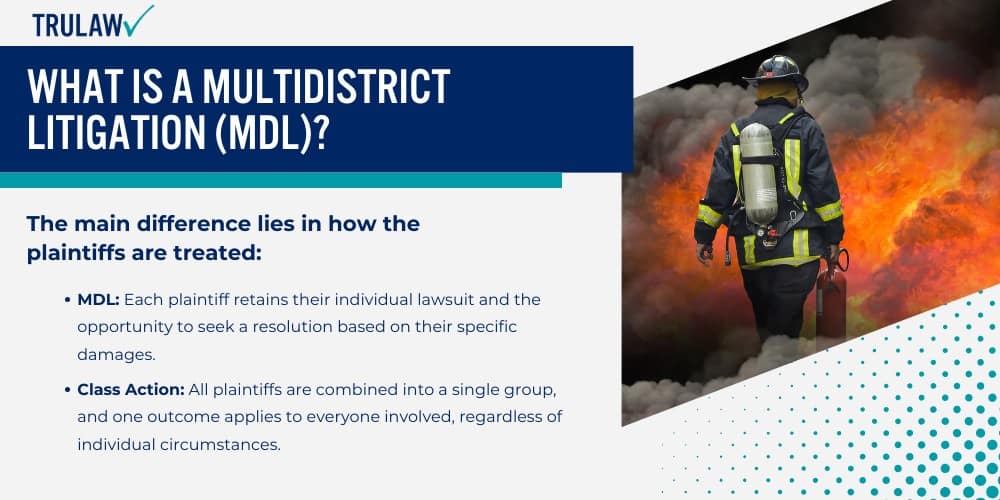
The main difference lies in how the plaintiffs are treated:
- MDL: Each plaintiff retains their individual lawsuit and the opportunity to seek a resolution based on their specific damages.
- Class Action: All plaintiffs are combined into a single group, and one outcome applies to everyone involved, regardless of individual circumstances.
Another distinction is how settlements are distributed.
- In MDLs, compensation is awarded based on the facts and damages of each individual case.
- In class actions, a lump-sum settlement is divided evenly among all plaintiffs, regardless of the unique impacts on each person.
How Does the MDL Process Work?
The MDL process simplifies litigation by consolidating AFFF lawsuits with common factual or legal issues.
Below are the core components of how an MDL functions.
Filing of Numerous Related Lawsuits
An MDL arises when multiple lawsuits with similar claims are filed, often involving similar injuries or harm caused by a specific product.
For AFFF lawsuits, the focus is on the health effects of PFAS exposure from firefighting foam, which has led to numerous cases being filed across the country.
Once a large number of related cases have been filed, the attorneys may request the Judicial Panel on Multidistrict Litigation (JPML) to centralize the cases for pretrial management.
Consolidating Similar Cases in an MDL
If the JPML grants the motion to centralize, the cases are transferred to a designated federal court for pretrial proceedings.
A single judge oversees the entire MDL to ensure consistency and efficiency in handling the litigation.
One of the key factors considered in choosing the court is the convenience of the plaintiffs.
Creating Order Within the MDL Parties
Once the cases are consolidated, a leadership structure is put in place, typically through the appointment of a steering committee.
This committee is responsible for organizing and coordinating the legal strategy for both plaintiffs and defendants.
While the steering committee oversees the broader aspects of the litigation, individual plaintiffs still retain their own legal representatives, ensuring that each case is handled according to its specific facts.
The Role of Bellwether Trials
To help assess the strength of the claims, a few representative cases are selected for trial.
These are known as bellwether trials.
The outcomes of these trials provide valuable insight into how future cases might proceed and can influence potential settlement negotiations.
Distribution of Mass MDL Settlements
If the bellwether trials result in favorable outcomes for the plaintiffs, it may prompt defendants to consider a settlement.
When a settlement is reached, it is distributed among the plaintiffs based on the specific details and damages of each individual case within the MDL.
This approach ensures that each plaintiff is compensated in line with their personal circumstances, rather than receiving an equal share as they would in a class action.