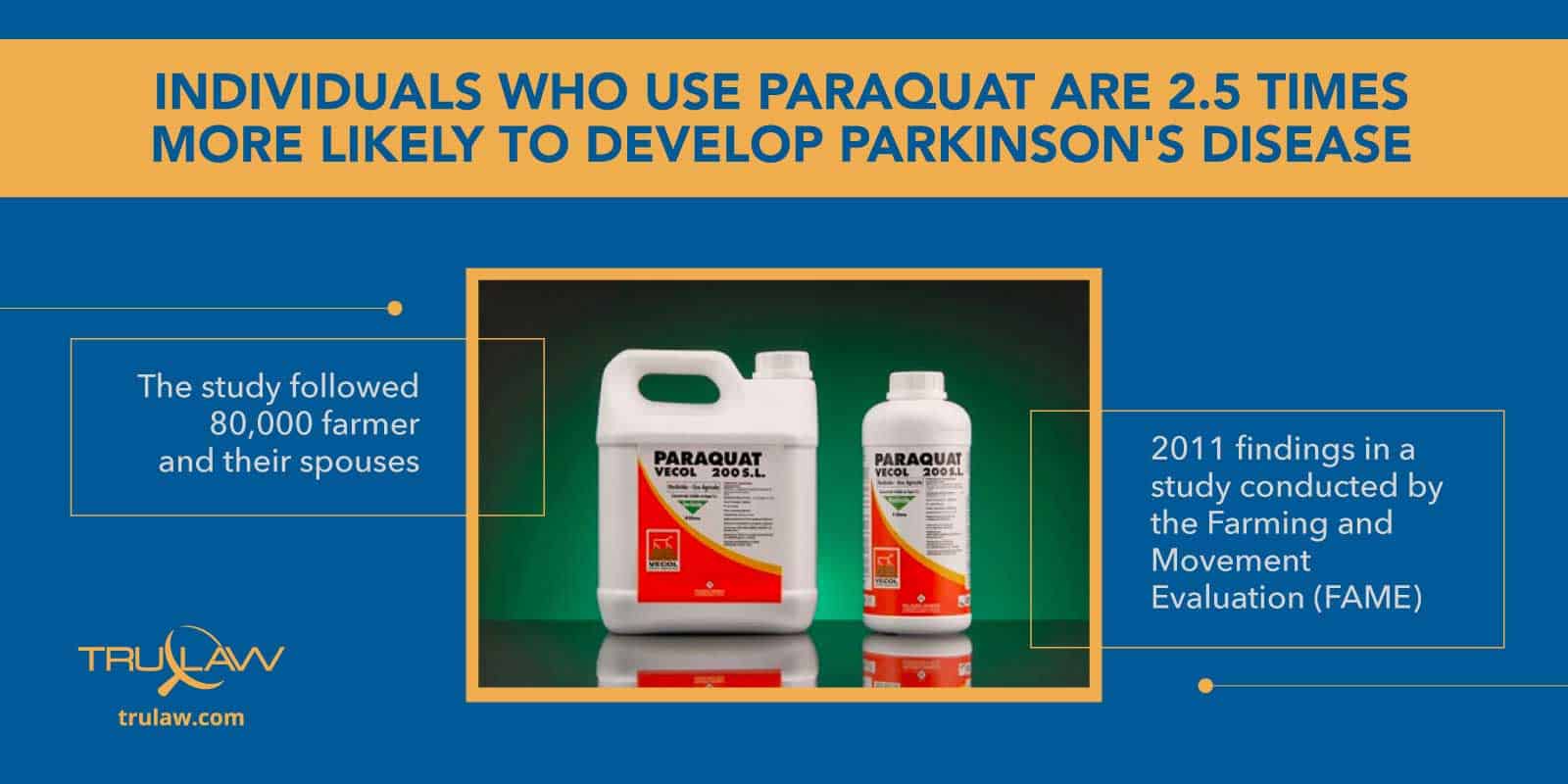
In 2011 a study was released known as the Farming and Movement Evaluation (FAME) study which investigated the relationship between Parkinson’s disease and exposure to pesticides that are toxic to nervous tissue.
This study found that people who used Paraquat developed Parkinson’s disease approximately 2.5 times more often than non-users.
The authors followed 110 people with Parkinson’s and 358 matched controls.
FAME was part of a larger Agricultural Health study that followed over 80,000 licensed pesticide applicators as well as their spouses.
This was a very influential study even among those who were skeptical of the connection between Paraquat and Parkinson’s.
On May 23, 2018, Scott Ryan, a University of Guelph professor in the Department of Molecular and Cellular Biology, published a study in which he determined that low-level exposure to pesticides like Paraquat disrupt cells in a way that mimics the effects of mutations known to cause Parkinson’s disease.
“People exposed to these chemicals are at about a 250% higher risk of developing Parkinson’s disease than the rest of the population,” said Ryan.

He believes that safety standards need to be updated to protect those who are more likely to develop Parkinson’s after pesticide exposure and may not even know it.
Currently, there is no cure or therapy to slow, stop or reverse the progression of Parkinson’s disease.
The exact cause of the disease is unknown, but research points to a combination of genetic and environmental factors.